Quick answer: Shani Levni is widely described online as a Tel Aviv-born multidisciplinary artist, writer and activist whose work explores identity, memory and belonging through mixed-media painting, installation and community art. The story told about her — born in Tel Aviv, trained at the Bezalel Academy of Arts and Design, later an MFA in Berlin, founder of a nonprofit called The Root Collective — is repeated across dozens of websites. But here is the honest part, and it matters more than the biography itself: the key facts conflict from one source to the next, there is no Wikipedia page and no mainstream news coverage to settle them, and no major museum or institution has publicly confirmed the exhibitions and awards the blogs claim. This article tells you the story as it circulates online, and then separates, claim by claim, what can be checked from what cannot.
If you searched for Shani Levni expecting a simple biography, you have probably already noticed something strange. Open five different pages about her and you will get five slightly different lives. One says she was born on April 15, 1990. Another says March 14, 1988. One says she founded The Root Collective in 2023. Another says 2017. One credits her with an Israel Ministry of Culture Award; the rest never mention it. One page even tells you she is an Ottoman miniaturist who died three hundred years ago, and another explains that “Shani Levni” is a Vedic astrology concept about the planet Saturn. None of those pages is lying in the ordinary sense — but they cannot all be right, and most of them are copying each other rather than reporting anything first-hand.
That confusion is exactly why this article exists. It does what the ranking pages do not: it reads them side by side, notes where they agree and where they contradict each other, checks what independent sources actually say, and tells you plainly where the record runs out. You will find the biography as it is commonly told, her art and its themes, the three works most often attached to her name, the story of The Root Collective, and a full section on what is not confirmed — including the two completely different “Shani Levnis” that search results keep mixing into hers.
Who Is Shani Levni?
According to the online story — repeated almost word for word across her own website shanilevni.com and a cluster of biography blogs — Shani Levni is a multidisciplinary artist, writer and cultural thinker from Tel Aviv, Israel. Her practice is said to span painting, mixed-media installation, performance and community programming, and her work is described as exploring identity, personal and collective memory, displacement, belonging, and social justice. She is presented as an artist who works quietly rather than loudly: community spaces, artist residencies and pop-up shows rather than the big commercial gallery circuit, with credibility built gradually through hybrid forms and open documentation of her creative process.
That description is consistent across the sources that carry it, which is worth noting — but consistency is not the same as verification. The same websites repeat the same paragraphs, often with identical phrasing, which is the signature of content that has been copied from a single origin rather than independently reported. The origin, in this case, appears to be shanilevni.com itself, a website that presents her biography alongside general articles on art, fashion, culture and beauty. One of the more honest pages in the cluster, flypapermagazine.co.uk, says this directly: verified public information about the individual remains limited, the narrative appears to have developed through repeated discussion across blogs rather than through large-scale exhibitions or mainstream coverage, and readers should approach the subject with caution. That is the correct starting point, and this article keeps it in view throughout.
There is one more thing to say before the biography begins. The name itself is real and meaningful. “Shani” is a Hebrew name, שָׁנִי, traditionally associated with the colour scarlet or crimson. “Levni” is a surname with its own history — most famously attached to Abdülcelil Levni, the Ottoman court miniaturist of the late seventeenth and early eighteenth centuries, who is a genuinely documented historical figure and who has nothing to do with the contemporary artist. The confusion between the two is not a small detail; it is the main reason search results for this name are so messy, and it gets its own section later in this article.
Quick Facts About Shani Levni
| Fact | What the online sources say | Verification status |
|---|---|---|
| Full name | Shani Levni | As presented on shanilevni.com |
| Date of birth | April 15, 1990 — or March 14, 1988 | Conflict: two different dates in different sources |
| Age (as of 2026) | 36 (if born 1990) or 38 (if born 1988) | Depends on which birth date is correct — unconfirmed |
| Place of birth | Tel Aviv, Israel | Repeated across sources, not independently confirmed |
| Nationality | Israeli | Described as Israeli everywhere; not independently confirmed |
| Education | BFA, Bezalel Academy of Arts and Design; MFA in Art Theory, Berlin | Repeated across sources, not independently confirmed |
| Profession | Multidisciplinary artist, writer, activist | As presented on shanilevni.com |
| Known for | Mixed-media art, community activism, installation | As presented across the blog cluster |
| Notable works | Whispers of the Olive Tree, Letters Never Sent, Between Earth and Sky | Named across sources; exhibition details unconfirmed |
| Nonprofit | The Root Collective | Founding year disputed: 2023 or 2017 |
| Exhibitions claimed | Tel Aviv Museum of Art, Jerusalem Biennale, Rosenfeld Gallery | Claimed by her site and the blogs; no independent confirmation found |
| Awards claimed | Israel Ministry of Culture Award (2020) — one source only | Single-source claim, unconfirmed |
| @shanilevni0011 (listed by one profile) | Unconfirmed | |
| Net worth | No figure given here | No reliable figure exists anywhere |
The table above is deliberately built differently from the ones on the ranking blogs. Their tables present every detail as settled fact. This one has a third column, because for Shani Levni the verification status is the story. A biography in which the birth date itself is disputed is not a biography with a few gaps; it is a biography that has never been properly reported by anyone with access to primary sources.
Early Life and Background
The story, as told by shanilevni.com and repeated by magazinedreamsinsider.com, sabaylok.com and others, goes like this. Shani Levni was born in Tel Aviv, Israel — most sources say April 15, 1990 — and grew up immersed in the city’s multicultural creative scene, surrounded by Jewish, Middle Eastern and European influences. Tel Aviv is, by any measure, a plausible setting for this story: it is a city with a genuinely active contemporary art scene, experimental creative communities, and a long history as a centre for emerging artists and multimedia creators. That plausibility is part of why the story reads so smoothly. A made-up biography usually borrows a real place and real institutions, and this one does exactly that.
Her education is described in consistent terms across the cluster. She is said to have completed a Bachelor of Fine Arts at the Bezalel Academy of Arts and Design in Jerusalem, with a focus on abstract expressionism, and then to have moved to Berlin to pursue a Master of Fine Arts in Art Theory, where she deepened her engagement with collective memory and European avant-garde movements. One profile adds that her MFA thesis was titled “Memory as Material” and became a cornerstone of her practice. Bezalel is a real and prestigious institution — widely regarded as one of the leading art schools in the Middle East — and the Berlin University of the Arts is likewise real. But no source in the cluster cites a graduation record, a thesis catalogue, or any document that would confirm that Shani Levni studied at either place. The claim is repeated, not evidenced, and this article records it as reported rather than verified.
It is worth pausing on why that distinction matters. For a public figure with a real institutional career, education is one of the easiest facts to check: universities publish alumni lists, degree shows are documented, and theses are catalogued. The absence of any such trace does not prove the claim false — many working artists have no public academic record — but it does mean the claim rests entirely on the word of a small group of websites that copy each other. A reader who wants certainty will not find it here, and an honest article should say so instead of repeating the claim with a straight face.
Artistic Style, Themes and Approach
If there is one part of the online portrait of Shani Levni that is consistent enough to describe with some confidence, it is the description of her artistic approach — not because it is verified, but because every source in the cluster describes it in the same terms, which at least tells us what her own presentation of herself emphasises. She is presented as a mixed-media artist who combines acrylic and oil paint with found objects, fabric, handwritten text, gold leaf and performative gestures. Her installations are described as layered and immersive, demanding participation rather than passive viewing: suspended fabric panels, projected light, recorded oral histories, and handwritten notes woven into the work.
The themes attributed to her are consistent too, and they form a coherent artistic identity:
- Identity and its formation — how a person becomes who they are across cultures, languages and borders.
- Personal and collective memory — what individuals and communities remember, forget, and pass on.
- Displacement and belonging — the experience of being between homes, countries and cultures.
- Heritage and the olive tree — the olive branch as a symbol of rootedness, endurance and peace.
- Spiritual resilience — art as a way of holding on to meaning under pressure.
- Art and social activism — creativity as a tool for dialogue, healing and measurable social change, not only as an aesthetic practice.
- Mental health — the therapeutic and communal dimensions of making art together.
One profile, ventsmagazines.co.uk, describes her style as “emotionally archaeological, digging beneath surfaces to recover what time and trauma have buried.” That is a vivid phrase, and it captures the tone of the whole portrait: an artist who treats the past as material to be excavated rather than as decoration. Whether or not the phrase comes from a real critic, it is a useful summary of the identity the online narrative constructs around her name.
Her working method, as described, is deliberately hybrid. She is said to move between painting, installation, performance and writing, and to treat those forms as parts of a single practice rather than as separate careers. The blogs also credit her with digital art innovation and creative leadership in 2026, though none of them specifies a particular digital project, platform or work — a vagueness that is itself characteristic of the cluster. When a claim has no specifics attached, it is usually because there are no specifics to attach.
Notable Works and Exhibitions
Three works are named again and again across the sources, and they form the core of the public catalogue attributed to Shani Levni. A fourth and fifth appear in some profiles but not others, which is itself a useful signal about how the story has grown by accretion — each new profile adding a detail the earlier ones did not have.
| Work | What the sources claim | Year / venue claimed |
|---|---|---|
| Whispers of the Olive Tree | Mixed-media installation using olive branches and Hebrew letters, addressing heritage, memory and the possibility of peace | Tel Aviv Museum of Art (year not consistently stated) |
| Letters Never Sent | Interactive installation built from unsent letters, exploring memory and unspoken words | Jerusalem Biennale |
| Between Earth and Sky | Installation of suspended fabric panels, projected light and recorded oral histories, exploring the boundary between the physical and the spiritual | Rosenfeld Gallery, 2020 (some sources say 2019) |
| A Parallel Universe | Installation presented in Berlin | Sputnik Gallery, Berlin, 2021 (one source only) |
| Climate migration project | Multimedia work with a Berlin data-visualisation studio, using real-time displacement data | Venice Architecture Biennale fringe, 2023 (one source only) |
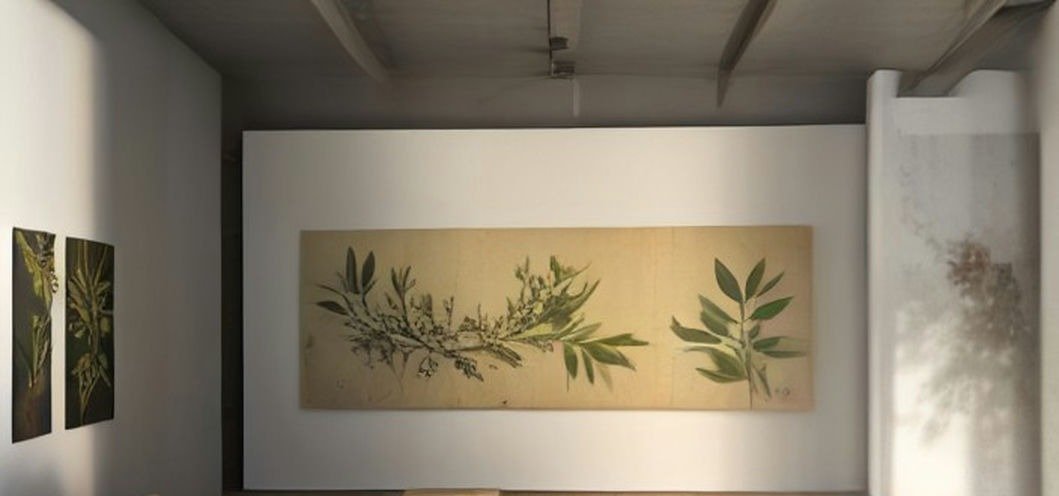
Whispers of the Olive Tree is the work most often described as her signature piece. According to shanilevni.com and the profiles that repeat it, it is a mixed-media installation shown at the Tel Aviv Museum of Art, built from olive branches and Hebrew letters, and concerned with heritage, memory and the possibility of peace. The olive tree is a resonant choice of material: in the region she is said to come from, it is a symbol of rootedness and endurance, and also of the contested histories of the land itself. If the work exists as described, it would be a serious and thoughtful piece. But no independent exhibition record, review or museum listing for it has been found, and the Tel Aviv Museum of Art’s public records do not surface it in the searches available for this article. That does not prove it was never shown — museum archives are incomplete online, and smaller shows are often poorly documented — but it means the claim is, at present, unverified.
Letters Never Sent is described as an interactive installation presented at the Jerusalem Biennale, built around letters that were written but never sent. The concept is a strong one: unsent letters are a universal image of things left unsaid, and an installation that invites visitors to contribute their own would fit naturally with the participatory approach attributed to her. The Jerusalem Biennale is a real and respected exhibition of contemporary Jewish art, held in Jerusalem. Again, though, no independent Biennale listing for this work has been found.
Between Earth and Sky is the work with the most specific claims attached to it: a solo show at Rosenfeld Gallery in 2020, using suspended fabric panels, projected light and recorded oral histories. Rosenfeld Gallery is a real Tel Aviv gallery. One source, ventsmagazines.co.uk, dates the same work to 2019 and describes it as her “most critically discussed” piece — a phrase that implies critical discussion which, so far, cannot be located. The date disagreement (2019 versus 2020) is a small thing, but it is the same pattern as the birth date and the Root Collective founding year: the details shift from source to source, which is what happens when information is copied and lightly rewritten rather than checked.
The two works that appear in only one source each — A Parallel Universe at Sputnik Gallery in Berlin in 2021, and a 2023 climate-migration collaboration with a Berlin data-visualisation studio, supposedly shown at the Venice Architecture Biennale fringe programme — should be treated with extra caution. Single-source claims in this cluster have a poor track record, and both of these read like additions made to flesh out a thin catalogue. A 2024 visual album co-created with an Israeli musician named Noa Levi is claimed by the same single source. None of these is confirmed anywhere else.
There is also the question of the collections. Ventsmagazines.co.uk claims her works are held in institutional collections including the Jewish Museum Berlin and the Tel Aviv University Art Archives, and that she has presented in galleries across Israel, Germany, France and the United Kingdom. No other source repeats the collections claim, and no collection listing has been found to support it. It is presented here as a claim, not a fact.
The Root Collective: Art as Social Change
If the exhibitions are the most glamorous part of the story, The Root Collective is presented as its moral centre. According to shanilevni.com and the profiles that follow it, Levni founded The Root Collective in 2023 — a nonprofit, based in Jaffa, that uses art workshops, community murals and installation projects to empower refugee and immigrant youth, giving young people tools to tell their own stories. The organisation is said to work across five countries, and more than 600 young people are said to have participated in its programmes, helping to create public murals and collaborative installations that have become visible parts of the communities where they were made.

That is a compelling mission, and it is the part of the story that readers most often respond to. It is also the part where the sources disagree most sharply. Ventsmagazines.co.uk says the organisation was founded in 2017, not 2023, operates across Berlin and Tel Aviv, has engaged over 2,000 participants across twelve countries, and has collaborated with the UNHCR and several European municipal governments. The two versions cannot both be right: a nonprofit founded in 2017 with 2,000 participants in twelve countries is a different organisation from one founded in 2023 with 600 participants in five countries. The disagreement is not a rounding error; it is a six-year gap and a fourfold difference in scale. No registration record, charity listing or independent report for an organisation of this name has been found to settle the question, and this article does not pretend otherwise.
The awards story follows the same pattern. Only ventsmagazines.co.uk claims that Levni received the Israel Ministry of Culture Award for Visual Arts in 2020 and that The Root Collective won the European Cultural Foundation’s Arts and Social Impact Prize in 2021. These are specific, checkable claims — prizes have winners’ lists — and neither has been confirmed. A profile on the same site also claims a TEDx talk at TEDx Jaffa in 2020, plans for a permanent community arts centre in Berlin’s Mitte district expected to open in 2027, and a major solo exhibition in Berlin titled “The Weight of Light,” focused on generational memory, with a book of visual work and essays to follow. The Weight of Light is also mentioned on shanilevni.com, which gives it slightly more weight than the single-source claims, but it remains an announced future project rather than a documented one.
What can be said with confidence is narrower: the name The Root Collective is consistently attached to Shani Levni across the online cluster, and the mission described for it — art workshops for refugee and immigrant youth — is consistent wherever it appears. The scale, the founding year and the institutional partnerships are not settled, and any reader who wants to support or verify the organisation should look for its own registration and reporting before doing so.
The Name Problem: Three Different “Shani Levnis”
A large part of why this name is so hard to research is that search results mix together at least three different things that share the name. Understanding the mix-up is essential to understanding the search results, and it is the part of this article most likely to save a reader from a mistake.
1. The contemporary artist
This is the Shani Levni described in the rest of this article: the Tel Aviv-born multidisciplinary artist of the online biography cluster. Her story is recent, dating from roughly 2025 onwards in search results, and it is built from the cluster of blogs described above.
2. Levni, the Ottoman miniaturist
The second “Shani Levni” in search results is not a contemporary artist at all. Abdülcelil Levni — often known simply as Levni — was one of the most celebrated miniaturists of the Ottoman court in the late seventeenth and early eighteenth centuries. His name is sometimes rendered in search results as “Shani Levni” because of the way the two words combine in headlines, and at least one magazine, venisonmagazine.com, has published a long article about him under the title “Shani Levni,” calling him “more traditionally known as Abdülcelil Levnî.”
Levni was born in Edirne around the 1680s and worked in the Nakışhane, the palace painting workshop, under Sultans Mustafa II and Ahmed III, during the period known as the Tulip Era. “Levni” was an artistic pseudonym derived from the Arabic root levn, meaning “colour” — he adopted it in reference to his mastery of colour and pigment, rather than using his birth name Abdülcelil. His most famous work is the Surname-i Vehbi, an illustrated manuscript commissioned in 1720 to commemorate the circumcision ceremony of four of Sultan Ahmed III’s sons, containing 137 richly coloured miniatures. He also produced the Kebir Musavver Silsilename, a genealogical album of Ottoman sultans, and numerous costume and daily-life miniatures. His works are held in the Topkapı Palace Museum Library in Istanbul, and he is cited as one of the last great court miniaturists before Westernising trends transformed Ottoman painting.
This Levni is a real, documented historical figure with a Wikipedia entry and a substantial scholarly literature. He is not Shani Levni, he did not live in Tel Aviv, and he did not found The Root Collective. Any page that attributes Ottoman miniatures to a contemporary Israeli artist, or a 1990 birth date to an eighteenth-century court painter, has confused the two — and several ranking pages do exactly that.
3. “Shani Levni” in Vedic astrology
The third meaning appears on sites such as dar-care.com, which present “Shani Levni” as a spiritual and astrological concept: the holistic impact and symbolic representation of the planet Saturn — called Shani in Vedic tradition — expressed as a flow or energy (“levni”) that shapes a person’s life through discipline, karma and life lessons. The article explains Shani as the strict teacher of the zodiac, discusses Sade Sati and Saturn Return, and recommends chanting the Shani Beej Mantra.
This usage is different again. “Shani” genuinely is the Vedic name for Saturn, and Saturn genuinely is called the Lord of Karma in that tradition. But “Shani Levni” is not a standard term in Vedic astrology — it appears to be a phrase constructed for search purposes, combining a real astrological name with a word that does not belong to that tradition. Readers looking for the artist should not confuse the two, and readers looking for astrology should know that the term itself is, at best, a modern invention.
| Meaning | Who or what it is | Real or not |
|---|---|---|
| Contemporary artist | Tel Aviv-born multidisciplinary artist of the blog cluster | Presented as real; details unverified |
| Ottoman miniaturist | Abdülcelil Levni, court painter, c. 1680s–1732 | Real, documented historical figure |
| Vedic astrology term | “Flow of Saturn’s karmic energy” | Phrase appears constructed for search; not a standard term |
The confusion between these three is not a minor footnote. It is the reason a search for “Shani Levni” returns an Ottoman manuscript, a Saturn mantra and a Berlin art collective on the same page — and it is the reason any article about the name that does not separate them is actively misleading its readers. For a similar lesson in how a single name can carry several unrelated meanings online, the story of Bilieter on this blog looks at a term the internet cannot agree on, and what that disagreement tells you about trusting your sources.
What Is Not Confirmed About Shani Levni
One of the most useful things an article about a thinly documented person can do is to be honest about the limits of what is known. The biography blogs that rank for Shani Levni rarely do this. They present guesses as facts, and they never tell the reader which parts of their story are invented. This section does the opposite.
Facts that are often stated but not verified
- Her date of birth. April 15, 1990, according to shanilevni.com, magazinedreamsinsider.com and sabaylok.com; March 14, 1988, according to ventsmagazines.co.uk. Both cannot be right, and no primary record settles it. Her age is therefore either 36 or 38 as of 2026, and this article does not choose between them.
- Her education. A BFA from Bezalel and an MFA in Art Theory in Berlin are claimed everywhere in the cluster and confirmed nowhere independently. The thesis title “Memory as Material” comes from a single profile.
- Her exhibitions. Shows at the Tel Aviv Museum of Art, the Jerusalem Biennale and Rosenfeld Gallery are claimed by her own site and repeated by the blogs. No independent exhibition listing, review or museum record has been found for any of them.
- The Root Collective’s founding year and scale. 2023 with 600 participants in five countries, or 2017 with 2,000 participants in twelve countries, depending on which profile you read. No registration or independent report found.
- Her awards. The Israel Ministry of Culture Award for Visual Arts (2020) and the European Cultural Foundation’s Arts and Social Impact Prize (2021) are claimed by one source only and are unconfirmed.
- Her collections. Works said to be held by the Jewish Museum Berlin and the Tel Aviv University Art Archives — one source only, unconfirmed.
- Her TEDx talk. A TEDx Jaffa talk in 2020 is claimed by one source only and is unconfirmed.
- Her social media. An Instagram account, @shanilevni0011, is listed by one profile. It is unconfirmed, and no verified public profile on any major platform has been established.
- Her partner and family. Ventsmagazines.co.uk names a spouse or partner, David Koren, and a father, Avi Levni. These names appear in no other source and are unconfirmed.
- Her net worth. No reliable figure exists anywhere. Any website that prints a specific dollar amount for Shani Levni’s net worth is inventing it. This article states no figure at all, because there is none to state.
- Her current residence. Tel Aviv and Berlin are both claimed, sometimes in the same profile. One source says she currently lives in Berlin; her own site presents her as Tel Aviv-based. Unconfirmed either way.
Why so much is unknown
There are two reasons so little is confirmed about Shani Levni, and they are different from the reasons that applied to a private person like Jill Rhodes. The first is that the public record for her is not thin because she avoids publicity — it is thin because the publicity itself is the record. The blogs are not reporting on a career that exists independently of them; in large part, they are the career’s public existence. The second is that none of the usual independent checks — a Wikipedia entry, a museum collection listing, a newspaper review, a prize winners’ list, a university alumni record — turns up anything. That combination should make any careful reader cautious. It does not prove that Shani Levni is not a real artist. It proves that the specific claims made about her have not been independently established, and that is a meaningful fact in itself.
The same discipline applies to other profiles on this blog. The profile of Aliza Barber faces a similar challenge — a person whose public record is thinner than the stories told about them — and it handles that challenge the same way: by sticking to what can be verified and saying plainly where the record runs out. That is what separates a useful profile from a content farm page.
How the Top Blogs Get Shani Levni Wrong
The five independent blogs that currently rank near the top for “shani levni” are shanilevni.com, magazinedreamsinsider.com, ventsmagazines.co.uk, sabaylok.com and flypapermagazine.co.uk. Reading them side by side is instructive, because the same weaknesses appear again and again — and because one of them is, unusually, honest about the problem.
| Competitor blog | Main weakness |
|---|---|
| shanilevni.com | The origin of the story, not an independent check on it; presents every claim as fact, including a general-articles blog under the artist’s name |
| magazinedreamsinsider.com | Repeats the 1990 birth date and the 2023 Root Collective founding without any independent sourcing; adds TEDx and UNESCO claims with no specifics |
| ventsmagazines.co.uk | Contradicts the other sources on the birth date (1988) and the Root Collective founding (2017); adds single-source awards, collections and a TEDx talk, none confirmed |
| sabaylok.com | A summary of shanilevni.com rather than an independent profile; repeats the same claims in the same order |
| flypapermagazine.co.uk | The most honest of the five: admits verified information is limited and the narrative developed through blogs repeating each other — but still repeats the unverified claims alongside the warning |
| ignorelimits.com | Vague on every specific — no dates, no venues, no works named with confidence; reads as filler around the keyword |
Two further pages are worth mentioning because they show how the name gets distorted. Venisonmagazine.com publishes a detailed and largely accurate account of the Ottoman miniaturist Levni under the headline “Shani Levni,” which guarantees that readers searching for the artist will find an eighteenth-century court painter instead. Dar-care.com does the same thing in a different direction, turning the name into a Vedic astrology concept about Saturn. Neither page is wrong about its own subject; both are wrong to present that subject under this name without explaining the difference.
The pattern across the whole cluster is the same: the blogs copy each other, the details drift with each copy, nobody checks anything against an independent source, and the reader is left with a biography that feels complete and is, in its specifics, unreliable. This article was written specifically to correct those gaps — with a quick-facts table that shows verification status, a full section on what is not confirmed, a clear separation of the three different “Shani Levnis,” and an honest statement of where the record runs out.
Frequently Asked Questions About Shani Levni
Who is Shani Levni?
Shani Levni is widely described online as a Tel Aviv-born multidisciplinary artist, writer and activist whose work explores identity, memory, belonging and social justice through mixed-media painting, installation and community art. She is said to have trained at the Bezalel Academy of Arts and Design and in Berlin, and to have founded a nonprofit called The Root Collective. The key biographical details conflict across sources and none has been independently verified by a major institution, so this article presents them as reported claims rather than settled facts.
How old is Shani Levni?
That depends on which source you believe. Her own website and several profiles give her birth date as April 15, 1990, which would make her 36 in 2026. Another profile, ventsmagazines.co.uk, gives March 14, 1988, which would make her 38. No primary record settles the question, so her age is unconfirmed.
What is Shani Levni known for?
She is known, according to the online profiles, for mixed-media installations and community art. The three works most often attached to her name are Whispers of the Olive Tree, Letters Never Sent and Between Earth and Sky, and she is credited with founding The Root Collective, a nonprofit that uses art workshops and murals to support refugee and immigrant youth. The exhibitions and the nonprofit’s scale are claimed by the blog cluster and are not independently confirmed.
What is The Root Collective?
The Root Collective is a nonprofit described as founded by Shani Levni to use art to empower refugee and immigrant youth through workshops, community murals and installation projects. Sources disagree on the founding year — 2023 according to her own site, 2017 according to another profile — and on the scale of its work, so both the date and the reach are unconfirmed.
Is Shani Levni the same person as Levni the Ottoman miniaturist?
No. Levni, properly Abdülcelil Levni, was an Ottoman court miniaturist active in the late seventeenth and early eighteenth centuries, famous for the Surname-i Vehbi manuscript of 1720. He is a documented historical figure whose works are held in the Topkapı Palace Museum Library. The two are different people who share a name, and several search results confuse them.
What is “Shani Levni” in astrology?
Some websites use “Shani Levni” to mean the flow or influence of Saturn — Shani in Vedic astrology — on a person’s life, connected with karma, discipline and life lessons. This is a different and unrelated usage of the same words, and “Shani Levni” is not a standard term in Vedic astrology.
Where can I see Shani Levni’s art?
According to the online profiles, her work has been shown at the Tel Aviv Museum of Art, the Jerusalem Biennale and Rosenfeld Gallery, and an upcoming solo exhibition in Berlin titled The Weight of Light has been announced. None of these exhibitions has been independently confirmed through a museum or gallery listing, so readers should check the venues directly before travelling.
Final Thoughts
Shani Levni’s story is, in the end, a story about what the internet does to a name. Somewhere in the cluster of pages that repeat her biography there may be a real artist, with a real practice, real works and a real nonprofit. The website that carries her name exists. The institutions named in her biography exist. The themes attributed to her work are coherent and serious. But the facts that would let a reader be sure — a birth record, a degree, an exhibition listing, a prize winners’ list, a charity registration, a single mainstream profile — are absent, and the facts that are offered contradict each other on the most basic points: when she was born, when she founded her organisation, where she lives now.
That is not a reason to dismiss her. It is a reason to read carefully. The honest version of Shani Levni’s story is not the polished biography the ranking pages offer, with its neat tables and confident dates. It is a shorter and more careful story: a name attached to a set of claims about a Tel Aviv-born artist, repeated so often that repetition has started to look like evidence, with real achievements possibly underneath and no independent way, yet, to separate them from the embellishment. The value of this article is not that it resolves the question. It is that it refuses to pretend the question is resolved.
If you came here looking for a simple biography, you now have something more useful than one: you know what is claimed, you know what conflicts, you know which other people and ideas share the name, and you know exactly where the record runs out. For readers who enjoy carefully researched profiles of figures whose public record is thinner than the stories around them, the story of Richard Giannotti on this blog takes the same approach — a profile built from what can be verified, with the gaps left visible instead of filled in. That discipline is what separates a useful profile from a content farm page, and it is the standard this article has tried to hold throughout.
