Quick answer: Supermaked is a coined online term for the modern, technology-enabled supermarket — a large self-service grocery store rebuilt around speed, choice and convenience, with self-checkout lanes, scan-and-go apps, click-and-collect ordering, smart shelves and personalised offers. It is not a single shop, chain or app, and there is no major retailer of that name. The word is best understood as shorthand for how grocery shopping has evolved, and the shopping experience it describes — ordering on your phone, scanning as you walk the aisles, and paying without joining a queue — is already familiar to millions of people.
If you searched for “supermaked” and expected to find a company, you are not alone. The word looks like a brand name, and several web pages written about it describe it as if it were a platform or a service. In reality, the evidence points the other way: there is no major retailer, app or company called Supermaked, and the word has no dictionary definition. What exists instead is a small cluster of recent blog posts that all use the word the same way — as a playful twist on “supermarket” to describe the next stage of grocery retail.
This article sorts out what is confirmed from what is only claimed. It explains the term honestly, describes the real technologies and shopping habits behind it, compares the supermaked-style store with the traditional supermarket, and gives you a practical guide to shopping that way — whether or not you ever use the word again. Where sources disagree or make claims that cannot be checked, that is flagged rather than hidden.
Supermaked at a Glance
| Detail | Information |
|---|---|
| Term | Supermaked |
| What it describes | The modern, technology-enabled supermarket |
| Is it a company or chain? | No — there is no major retailer, app or company of that name |
| Dictionary definition | None — it is a coined online term, not standard English |
| Closest standard word | Supermarket |
| Related Scandinavian word | Supermarked (Danish and Norwegian for “supermarket”) |
| Core features | Self-checkout, scan-and-go apps, click-and-collect, smart shelves, personalised offers, real-time stock tracking |
| First online articles using the term | 2025–2026, on small independent blogs |
| A website using the name | Supermaked.com exists and uses the word as an online identity connected with grocery shopping and local markets (unverified as a major retailer) |
| What to do with the term | Treat it as a concept, not a place you can visit |
Confirmed vs Claimed: What the Sources Say
Because “supermaked” is a new and unofficial word, the pages about it do not all say the same thing. Some describe it as a concept, others write about it as though it were a product or a platform, and a few attach statistics and feature lists that cannot be traced to any primary source. The table below sorts the main details into confirmed facts, supported claims, and claims that should be treated with caution.
| Detail | Status | What we know |
|---|---|---|
| Supermaked is a coined term for the modern tech-enabled supermarket | Confirmed | hotteamnames.com, trellispost.com and wizroo.com agree |
| It is not a single shop, chain or app | Confirmed | hotteamnames.com states this explicitly; no retailer of the name appears in any major listing |
| There is no dictionary definition | Confirmed | The word does not appear in standard English dictionaries; “supermarket” is the correct standard word |
| Supermaked.com exists as a website using the name | Reported | Per bizznavigators.com; its homepage describes the term as a variation of “supermarket” |
| The word is a spelling variation or typo of “supermarket” | Claimed | bizznavigators.com treats it this way; other sources treat it as an intentional coined term — both readings exist |
| Supermarked is Danish/Norwegian for “supermarket” | Confirmed | Cambridge Danish dictionary and Store norske leksikon |
| A supermaked-style store uses AI, IoT smart shelves and computer vision checkout | Claimed | wizroo.com describes these as defining technologies; they are real technologies used by some modern supermarkets, but no single store combines all of them under this name |
| Supermaked “eliminates queues” and “drastically reduces food waste” | Claimed | wizroo.com; these are marketing-style claims, not measured results from a named store |
| Statistics on smart retail adoption cited in supermaked articles | Unverified | wizroo.com presents industry statistics without traceable primary sources; treat the numbers as illustrative, not verified |
| “SUPER Medicare” is related to supermaked | False | A search for “supermaked” also surfaces “SUPER Medicare,” a nickname some doctors use for Medicare Supplement Plans F and G — an unrelated topic that only matches because of the similar spelling |
The distinction matters. The honest core of the term — a modern supermarket rebuilt around technology and convenience — is supported by several independent sources and by the visible reality of grocery shopping in 2026. The grander claims — a revolution, a platform, hard statistics — come from single blog posts with no primary source behind them, and they are flagged as claims here rather than repeated as facts.
What Does Supermaked Mean?
The simplest answer is that “supermaked” means a supermarket that has been made over — made smarter, faster and more convenient — for the way people shop now. The word blends “super” with a sense of something refined or optimised, and the writers who use it are describing a store where the weekly shop is no longer a slow chore of pushing a trolley down every aisle and queuing at a till.
A supermaked-style store typically combines most of the following features:
- Self-checkout lanes where you scan and pay for your own shopping without a cashier.
- Scan-and-go apps that let you scan items with your phone as you walk the aisles, then pay in the app and leave.
- Click-and-collect ordering, where you order groceries on your phone or computer and collect them from the store, a locker or a drive-through bay.
- Real-time stock tracking, so the app can tell you whether an item is actually on the shelf before you drive to the store.
- Personalised offers, where the store’s app suggests deals based on what you usually buy.
- Clear, shopper-first layout, with wide aisles, clear sightlines and sections grouped the way people actually shop — breakfast foods together, dinner ingredients together — rather than the way a warehouse would organise them for restocking.
- Checkout flexibility, with more than one way to pay and leave: a traditional cashier lane, a self-checkout kiosk, or a scan-and-go app.
None of these features is new on its own. Self-checkout has been in supermarkets for more than two decades. Click-and-collect became mainstream during the pandemic years. What is new is the combination: a store where all of these options exist at once, and where the shopper chooses the route that fits the trip — a fast top-up shop scanned on a phone, a big weekly shop ordered online and collected, or a slow browse with a trolley and a cashier.
Is Supermaked the Same as Supermarket?
Not exactly, and the difference is worth stating clearly, because it is the source of most of the confusion around the word.
Supermarket is the established English word for a large self-service store selling food, drinks and household products. It has been in use for nearly a century, it appears in every dictionary, and it describes a type of store, not a brand.
Supermaked, on the other hand, does not have the same established dictionary status in English. Current online usage shows it being treated in three different ways: as a spelling variation of “supermarket,” as an intentional coined name (most visibly by Supermaked.com), and as a descriptive label for the modern, tech-enabled supermarket. None of those uses makes it a standard word, and if you are writing normal English, “supermarket” is the correct spelling.
Supermarked is a different word again, and an established one — it is the Danish and Norwegian word for supermarket. Cambridge’s Danish dictionary translates “supermarked” as “supermarket,” and the Norwegian Store norske leksikon defines it as a larger grocery store carrying a broad range of everyday consumer products. The Scandinavian form keeps the “r” that “supermaked” drops, which is a useful clue: if you see “supermarked” with an “r,” it is almost certainly Danish or Norwegian; if you see “supermaked” without one, it is the newer English online coinage.
| Term | Language and context | Meaning |
|---|---|---|
| Supermarket | Standard English | A large self-service grocery store |
| Supermaked | English online usage | Coined term for the modern tech-enabled supermarket; also a website name |
| Supermarked | Danish and Norwegian | Supermarket |
| Grocery store | General English | A store selling food and household items |
| Hypermarket | Standard English | A very large supermarket combined with a department store |
Why Are People Talking About Supermaked in 2026?
The word is gaining attention because the shopping habits it describes have become normal, and because shoppers’ expectations have changed. People now expect the same speed and convenience from a grocery store that they get from ordering a taxi or streaming a film: they want to know before they leave home whether an item is in stock, they want to pay without queuing, and they want the store to remember what they usually buy.
Supermaked fits directly into that shift because it represents stores built around saving time rather than just stocking shelves. The word itself is new, but the expectation behind it is not: shoppers have been asking for faster checkouts, better apps and easier collection for years, and the stores that deliver those things are the ones winning the weekly shop. In that sense, “supermaked” is less a new invention than a new label for a change that was already happening — the supermarket, updated for shoppers who carry a supercomputer in their pocket.
There is also a simpler, search-driven reason the word is spreading. Made-up and near-misspelled words attract articles, because each new article gives the word a little more visibility, and each new page about it makes the next writer more likely to use it. That feedback loop is common online, and it is one of the reasons this article is careful to separate what the word means from what individual articles claim about it. A word can be widely written about without being widely used, and “supermaked” is a good example: the articles about it outnumber the shops that could plausibly be described by it.
A Short History of the Supermarket — How We Got to Supermaked
To understand what a supermaked-style store is, it helps to know what it replaced, because every feature of the modern store is an answer to a frustration of the older one.
The self-service grocery store was itself once a radical idea. Before it, shoppers handed a list to a clerk, who fetched each item from behind a counter. The first self-service store is generally credited to Piggly Wiggly, opened in Memphis in 1916, where customers walked the aisles and picked their own goods off the shelves. The idea spread slowly at first, then quickly: King Kullen, often called the first true supermarket, opened on Long Island in 1930, combining self-service with low prices, large floor space and free parking. By the middle of the century, the supermarket — big, bright, self-service, and organised by department — had become the default way to buy food in the United States and, later, in much of the rest of the world.
Each decade since has added a layer. Barcodes, introduced widely in the 1970s and 1980s, made checkout faster and stock-keeping automatic. Loyalty cards, from the 1990s onwards, let stores track what regular customers bought and offer them targeted discounts. Self-checkout lanes arrived in the early 2000s, first as a novelty and then as a standard fixture. Online grocery ordering and home delivery grew through the 2010s and surged during the pandemic, when click-and-collect went from a niche service to a mainstream one in a matter of months.
Supermaked is simply the latest chapter in that story. It is not a break with the supermarket’s history but a continuation of it: each generation of the store has used the technology of its time to remove a little more friction from the weekly shop, and the supermaked-style store is the version that uses the smartphone, the app and the sensor to do the same job. The trolley and the shelf are still there. What has changed is everything around them.
| Era | The change | What it removed |
|---|---|---|
| 1916, Piggly Wiggly | Self-service aisles | Waiting for a clerk to fetch each item |
| 1930, King Kullen | The large low-price supermarket | Small shops, high prices, no parking |
| 1970s–1980s | Barcodes and scanners | Manual price entry and slow checkouts |
| 1990s | Loyalty cards | One-price-for-everyone shopping |
| 2000s | Self-checkout lanes | Queuing for a cashier on every trip |
| 2010s | Online ordering and delivery | The need to visit the store at all |
| 2020s | Click-and-collect, scan-and-go, smart shelves | Queues, stock surprises, and the weekly time sink |
What Makes a Store “Supermaked”?
A supermaked-style store is not defined by any single feature. It is defined by the combination, and by the intent behind it: the store is organised around the shopper’s time rather than the store’s convenience. Here are the features that show up again and again in descriptions of the concept, with an honest note on how common each one really is.
1. Layout Designed for Shoppers, Not Warehouses
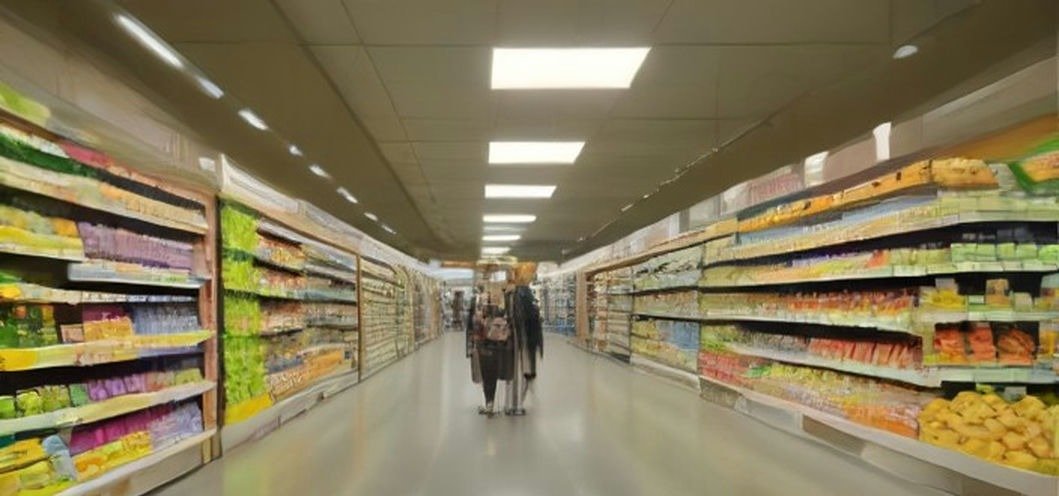
The first thing writers about supermaked notice is the layout. Traditional supermarkets were often organised for restocking convenience: heavy goods near the loading bay, long aisles of identical shelving, and departments arranged by supplier rather than by meal. A supermaked-style store, by contrast, is described as having clear sightlines, wide aisles, and sections grouped the way people actually shop — so that everything for a Tuesday dinner sits near everything else for a Tuesday dinner, and the breakfast foods are together rather than scattered across the store.
This is partly a design claim and partly a description of a real trend. Many modern supermarkets have redesigned their layouts around “food for tonight” and “food for later” zones, and around placing fresh produce at the entrance, where it sets the tone for the shop. Whether any given store has done this well is something you can judge in thirty seconds of walking through the door: if you can see across the store, find what you need without doubling back, and reach the till without a maze, the layout is working.
2. Self-Checkout and Scan-and-Go
Self-service is the defining piece of the supermaked idea, and it comes in two forms. Self-checkout lanes, where you scan your items at a kiosk and pay by card, are now standard in most large supermarkets in the United States, the United Kingdom and much of Europe. Scan-and-go goes a step further: you scan each item with your phone or a store handset as you put it in your basket, then pay in the app and walk out, sometimes through a dedicated exit with a random basket check.
The appeal is obvious — no queue, no unloading the trolley onto a belt, no waiting while the person ahead of you argues about a coupon. The frustrations are real too: produce that needs weighing, age-restricted items that need a staff check, scanners that misread barcodes, and the occasional random audit that asks you to rescan your whole basket. A well-run supermaked-style store keeps staffed lanes open alongside the self-service ones, because the point is choice, not forcing everyone through the same kiosk.
3. Click-and-Collect and Delivery
Click-and-collect is the feature that most clearly separates the modern store from its predecessor. You order on the app or website, choose a collection slot, and pick the order up from the store, a locker or a drive-through bay — often without leaving your car. Some stores now fulfil these orders from the shop floor, with staff picking items from the same shelves shoppers use; others fulfil them from a separate warehouse or a “dark store” that the public never enters.
The practical advantage is time: a weekly shop that takes an hour on foot can take ten minutes of collection. The trade-off is control: someone else picks your fruit, your meat and your bread, and if an item is out of stock you get a substitution or a refund rather than the chance to choose an alternative yourself. Good click-and-collect services let you set substitution preferences in advance — “always substitute,” “never substitute,” or “substitute only with this brand” — and the best ones are honest about what was substituted and why.
4. Real-Time Stock and Personalised Offers
Behind the app sits the least visible part of the supermaked idea: the store’s inventory system. In a traditional supermarket, you discovered an item was out of stock when you reached an empty shelf. In a supermaked-style store, the app is supposed to know before you leave home, because shelf sensors, electronic shelf labels and the store’s stock system are connected. In practice, this works well for fast-moving items and badly for the odd item that a single shopper has just taken from the shelf, so it is best treated as usually accurate rather than perfectly reliable.
Personalised offers work the same way: the app looks at what you usually buy and offers you discounts on those items, or suggests a new product in a category you already shop. This is genuinely useful when it surfaces a real saving on something you were going to buy anyway, and genuinely irritating when it pushes products you have no interest in. The privacy trade-off is real — the store knows a great deal about your household from your shopping history — and the later section on privacy covers what to do about it.
5. Smart Shelves, Dynamic Pricing and Computer Vision
The more ambitious descriptions of supermaked invoke a layer of technology that is real but unevenly deployed: Internet of Things (IoT) smart shelves that detect when stock is low, electronic shelf labels that change prices remotely, and computer vision systems that watch what you pick up and charge you as you leave — the “just walk out” model pioneered by Amazon Go stores.
Each of these exists. Electronic shelf labels are now common in European supermarkets and are spreading in the United States, because they let a store change hundreds of prices in minutes and cut the labour of printing paper labels. Smart shelves that report stock levels are in use in some large stores, though they are far from universal. Fully checkout-free computer vision stores exist, but they remain a small minority, and several high-profile rollouts have been scaled back or rethought after proving expensive to run and prone to errors — including reports that human reviewers were needed far more often than the marketing suggested.
The honest summary is this: the technology described in supermaked articles is real, but a store that has all of it at once is the exception, not the rule. Most shoppers’ experience of a “supermaked” in 2026 is a normal supermarket with a good app, working self-checkout and a decent click-and-collect service — and that is already a large improvement on the store of twenty years ago.
6. Augmented Reality in the Aisle
One feature that appears in the more futuristic supermaked articles is augmented reality (AR): point your phone at a shelf and see product information, allergen warnings, recipe suggestions or a route to the next item on your list overlaid on the camera view. This is a real capability — several retailers and app makers have demonstrated it — but it is not yet a normal part of grocery shopping anywhere, and it should be treated as an emerging idea rather than a feature you can expect on your next shop. If your store’s app offers an in-store navigation or list-routing feature, that is the practical version of the same idea, and it is worth using: it can cut several minutes off a weekly shop by ordering your list to match the store’s layout.
Supermaked vs Traditional Supermarket: A Clear Comparison
The table below brings the differences together. It is a comparison of the supermaked-style store as described by its promoters with the traditional supermarket as it existed for most of the twentieth century — not a claim that every modern store has every feature in the right-hand column.
| Feature | Traditional supermarket | Supermaked-style store |
|---|---|---|
| Checkout | Cashier lanes only | Cashier lanes, self-checkout, scan-and-go |
| Ordering | In-store only | In-store, app, website, click-and-collect, delivery |
| Stock information | Discover on the shelf | App shows availability before you travel |
| Pricing | Paper labels, changed by hand | Electronic shelf labels, changed remotely |
| Offers | Paper coupons, weekly flyer | Personalised app offers based on your history |
| Layout | Organised for restocking | Organised around how shoppers cook and eat |
| Payment | Cash or card at the till | Card, phone, app, contactless, checkout-free |
| Time for a weekly shop | 60–90 minutes in store | 10 minutes collection, or a faster in-store trip |
| Staff role | Till operators and shelf stackers | Pickers, app support, and floor staff who help |
| Data collected | Loyalty card purchases | Full app history, location, browsing and list data |
The comparison also shows the trade-off that the enthusiastic articles tend to skip. Every convenience in the right-hand column is paid for with data. A traditional supermarket knew what you bought if you used a loyalty card; a supermaked-style store knows what you browsed, when you shopped, where you were in the store, what you searched for and did not buy, and what you put back on the shelf. That data is what makes the personalised offers and the stock predictions possible, and it is also what makes the privacy section of this article necessary.
How to Shop the Supermaked Way: A Practical Guide
You do not need a store that calls itself a supermaked to shop this way. The habits below work in any modern supermarket with an app, self-checkout and click-and-collect, and they are the practical core of the concept — the part that saves real time and real money.
Step 1: Set Up the Store App Before You Go
Download your regular store’s app at home, not in the car park. Create the account, add your loyalty card, and set your substitution preferences for click-and-collect before you need them. Check whether the app shows live stock for your store — some do, some only show whether an item is “usually stocked” — and learn the difference, because an item marked “in stock” that is not on the shelf is the most common frustration of app-based shopping.
Step 2: Build a Standing List
Most grocery apps let you save a standing list of the items you buy every week: milk, bread, eggs, coffee, the same vegetables, the same cleaning products. Build that list once, carefully, and the weekly shop becomes a matter of reviewing it and adding the extras for that week, rather than starting from a blank screen every time. Keep the list in the app rather than on paper, because the app can then tell you the running total and flag items that are out of stock before you order.
Step 3: Choose the Right Trip for the Right Shop
Not every shop should be the same kind of trip. Use the method that fits the job:
- The big weekly shop: order online and collect it, or have it delivered. This is where click-and-collect saves the most time.
- The top-up shop: go in person with scan-and-go, if your store offers it, and buy only what is on the list.
- The browse: go in person with a trolley when you actually want to discover new products, check fresh produce yourself, or shop without a plan.
- The urgent item: check the app for stock, then go in person and use self-checkout.
Mixing the methods is the point. The shoppers who get the most from the modern supermarket are not the ones who use one channel for everything, but the ones who match the channel to the trip.
Step 4: Use Self-Checkout Well
Self-checkout is fastest when you treat it as a skill. A few habits make a real difference:
- Bag as you scan, rather than scanning everything and then bagging it all at the end.
- Put loose produce on the scale before scanning the barcode, so the machine does not stop and wait.
- Keep age-restricted items together and have ID ready, so the staff check happens once.
- If the machine stops and calls for assistance, wait — trying to press buttons faster usually makes it worse.
- If you have a very large shop, use a staffed lane. Self-checkout is designed for speed on small and medium shops, not for a trolley piled to the top.
Step 5: Check Substitutions and Prices Before You Leave
For click-and-collect orders, check the confirmation message before you drive to the store. If items were substituted, decide whether the substitution is acceptable — if it is not, most stores will remove it and refund you at collection. Check the total against your budget in the app, not after you have paid. And keep the receipt: for app orders, the receipt is usually in the app, and it is the record you need if something is missing or wrong.
Step 6: Review Your Offers, Don’t Chase Them
Personalised offers save money only when they discount something you were going to buy anyway. Before you add an offer item to your basket, ask one question: would I have bought this without the discount? If the answer is no, the offer has cost you money, not saved it. The most useful offers are almost always on your regular items — the same coffee, the same washing powder, the same bread — and the least useful are on new products the store wants you to try.
The Three-Zone Walk: A Simple In-Store System
For the in-person shop, one practical system is worth borrowing from the supermaked articles: the three-zone walk. It is a way of moving through the store once, in order, instead of wandering back and forth.
- Zone 1 — Fresh: produce, bakery, meat and dairy, usually around the edge of the store. Buy what needs choosing by eye and hand.
- Zone 2 — Pantry: the centre aisles — tins, pasta, rice, sauces, cleaning products. This is the zone where a standing list saves the most time, because these are the items you buy the same way every week.
- Zone 3 — Frozen and checkout: frozen food last, so it stays frozen, then straight to the checkout of your choice.
The system works because it matches the store’s own layout — fresh around the edges, pantry in the middle, frozen near the tills — and because it turns the shop into a single loop. It is not a technology, and it does not need an app. It is the low-tech version of the same idea the supermaked concept is built on: organise the shop around the shopper, not around the store.
Sustainability: The Green Claims, Examined Honestly
The supermaked articles make strong environmental claims — that smart inventory tracking “drastically reduces food waste,” that dynamic pricing cuts waste by discounting food near its expiry date, and that the model is inherently more sustainable than the traditional supermarket. Some of this is true, and some of it is overstated, so it is worth separating the two.
What is genuinely true is that better stock information reduces waste. A store that knows exactly what it has, what is selling and what is about to expire can order more accurately, discount items before they spoil, and donate or redirect food that will not sell. Dynamic pricing — reducing the price of an item as its expiry date approaches — is a real and effective tool for this, and it is already in use in many supermarkets, with or without the “supermaked” label. Click-and-collect and delivery also reduce waste in one specific way: because the order is picked from stock data rather than from a shopper’s wandering, the store’s picture of what is selling stays cleaner.
What is overstated is the scale of the claim. Food waste in grocery retail comes mostly from over-ordering, from fresh produce that spoils before it sells, and from shoppers buying food they do not eat — and the last of those, household food waste, is larger than retail waste in most countries. A smarter store can cut its own waste, but it cannot stop a household from buying too much, and an app that makes ordering easier can just as easily make over-ordering easier. The honest version of the sustainability claim is narrower: supermaked-style tools help a store waste less of its own stock, and dynamic pricing helps sell food before it spoils, but they do not by themselves make grocery shopping sustainable. That depends on what shoppers buy, how much they throw away, and how the food was produced in the first place.
There is also a counterweight the enthusiastic articles rarely mention: the environmental cost of the technology itself. Electronic shelf labels, shelf sensors, app servers, delivery vans and the packaging for click-and-collect orders all have a footprint. Delivery, in particular, is a mixed picture — one van delivering to twenty households is more efficient than twenty cars driving to the store, but a van making single-item urgent deliveries is not. The net effect depends on how the service is run, and no supermaked article provides the data to settle it.
Privacy and Data: What the Store Knows About You
This is the part of the supermaked idea that deserves the most careful attention, because it is the part the promotional articles mention least. A supermaked-style store runs on data, and the data it collects goes well beyond a loyalty card.
A loyalty card recorded what you bought. A grocery app can record what you searched for and did not buy, what you put in your basket and removed, how long you spent in each aisle, which offers you looked at, where you were when you opened the app, and what device you used. Combined with your purchase history, that is a detailed picture of your household: what you eat, when you eat it, how much you spend, whether you have a baby, a pet, an allergy, or a medical diet.
That is not a reason to refuse to use the app. It is a reason to use it deliberately. A few practical steps keep the trade-off in your favour:
- Read the app’s privacy settings once. Most grocery apps let you turn off location tracking, targeted advertising and data sharing with third parties. Turn off what you do not need.
- Use the loyalty price, not the data price. You can usually get the member prices without enabling every tracking feature the app offers.
- Do not link the grocery app to other accounts — social media, payment apps, health apps — unless there is a clear benefit, because each link widens the picture.
- Check what is shared. Some apps share anonymised purchase data with suppliers and advertisers. The setting that controls this is usually under “privacy” or “data sharing,” not under “offers.”
- Remember that a discount is a payment. When a store gives you a personalised offer, it is paying you — in a small discount — for information about your household. That is a fair trade when the discount is on something you buy anyway, and a bad trade when it is not.
The broader point is that the supermaked model is not free. The convenience is paid for partly in money and partly in data, and a shopper who understands that can decide, aisle by aisle and setting by setting, how much of each they are willing to spend.
Does Shopping the Supermaked Way Actually Save Money?
The short answer is that it can, but not automatically, and not for the reasons the promotional articles suggest. The savings come from three specific mechanisms, and each one has a condition attached.
Fewer impulse buys. Ordering online or scanning with a list removes the two biggest sources of unplanned spending: the end-of-aisle display and the queue-side snack rack. Shoppers who switch to click-and-collect often report spending less, not because the prices are lower but because they buy only what is on the list. The condition is that the list is honest — a list that includes treats you planned for is a budget; a list padded with “essentials” you did not need is not.
Better use of offers. Personalised offers and dynamic pricing can cut the cost of a regular shop by a noticeable amount, but only on items you buy repeatedly. The condition is discipline: an offer saves money only when it discounts something you would have bought at full price. An offer that persuades you to buy something extra is a cost dressed up as a saving.
Less waste. Buying only what you need, and buying it in the right quantities, cuts the money lost to food thrown away. This is the largest and least visible saving of all — households in many countries throw away a significant share of the food they buy — and it is also the hardest to measure, because nobody keeps a receipt for the bin. The condition is that the convenience of ordering does not lead to ordering more than you need.
There are also costs that the articles rarely mention. Delivery and collection fees, where they apply, eat into the savings. Minimum order values can push you to add items you do not need. And the app’s convenience can encourage more frequent, smaller shops, which usually cost more per item than one planned weekly shop. The honest accounting is that the supermaked way of shopping saves money for shoppers who plan, and costs money for shoppers who do not — which is the same rule that applied to the traditional supermarket, just with a faster app attached.
| Saving mechanism | How it works | When it fails |
|---|---|---|
| Fewer impulse buys | List-based ordering removes aisle displays and queue snacks | When the list itself is padded with unplanned items |
| Personalised offers | Discounts on items you buy repeatedly | When offers persuade you to buy something extra |
| Less food waste | Right quantities, dynamic pricing near expiry | When easy ordering leads to over-ordering |
| Time saved | Collection or a faster in-store trip | When delivery fees and minimum orders add cost |
| Price comparison | App shows the running total before checkout | When you stop checking the total because the app does it for you |
The Future of Supermaked: What Comes Next
The supermaked concept, as described in the 2025–2026 articles, points in a consistent direction: more automation, more personalisation, and fewer queues. Some of that future is already arriving. Electronic shelf labels are spreading. Self-checkout is being refined rather than removed. Click-and-collect is being joined by rapid delivery from small urban warehouses. Recipe-to-basket features — tap a recipe and have its ingredients added to your order — are becoming a standard app feature, and they are the most useful version of personalisation yet, because they save planning time rather than just offering discounts.
Other parts of the vision are further away or may not arrive at all. Fully checkout-free stores have proved expensive and difficult to run at scale, and several retailers have quietly reduced their ambitions there. Augmented reality shopping remains a demonstration rather than a daily habit. And the most important limit on the future is not technological but human: many shoppers still want to choose their own fruit, talk to a member of staff, and browse without an app telling them where to go. The stores that succeed will be the ones that keep those options open while adding the new ones, rather than the ones that force every shopper through the same digital funnel.
One prediction can be made with more confidence than the rest: the word “supermaked” itself will probably not last. Coined terms that describe a real change sometimes survive — “supermarket” itself was once a new word — but most of them fade, and the change they described continues under a plainer name. In ten years, the features this article describes will probably just be called “the supermarket,” and the word “supermaked” will be a curiosity from the mid-2020s. That does not make the concept unimportant. It makes the article’s job simpler: what matters is not the word, but the shopping habits it points to, and those are already here.
Frequently Asked Questions About Supermaked
What is Supermaked?
Supermaked is a coined online term for the modern, technology-enabled supermarket — a large self-service grocery store rebuilt around speed, choice and convenience, with self-checkout, scan-and-go apps, click-and-collect ordering, smart shelves and personalised offers. It is not a single shop, chain or app, and there is no major retailer of that name.
Is Supermaked a real company?
No. There is no major retailer, website or app called Supermaked that operates as a supermarket chain. Supermaked.com exists as a website that uses the word as an online identity connected with grocery shopping and local markets, but that does not make it a major retailer, and it should not be confused with a supermarket you can visit.
Is “supermaked” a real word?
Not in standard English. It has no dictionary definition, and the correct standard word for the store is “supermarket.” “Supermaked” is used online as a coined term and a website name. The similar-looking word “supermarked” is a real word in Danish and Norwegian, where it means “supermarket.”
What is the difference between a supermaked and a supermarket?
A supermarket is the standard large self-service grocery store. A supermaked-style store is a supermarket with modern technology layered on top: self-checkout and scan-and-go, click-and-collect, real-time stock in an app, personalised offers, and sometimes smart shelves and electronic price labels. The difference is one of degree — most large supermarkets in 2026 already have several of these features.
Does a supermaked have self-checkout?
Yes — self-checkout is one of the defining features of the supermaked-style store, alongside scan-and-go apps. A well-run store keeps staffed lanes open as well, because the point is choice: some shoppers want the fastest exit, and others want a cashier.
Is Supermaked the same as SUPER Medicare?
No. “SUPER Medicare” is an unrelated nickname that some doctors use for Medicare Supplement Plans F and G. It appears in searches for “supermaked” only because the spelling is similar. It has nothing to do with grocery shopping.
Does shopping the supermaked way save money?
It can, mainly by reducing impulse buys, using personalised offers on items you buy anyway, and wasting less food. It does not save money automatically: delivery fees, minimum orders and offers that persuade you to buy extra items can wipe out the savings. The shoppers who save money are the ones who plan with a list.
Is my data safe in a supermaked app?
A grocery app collects more data than a loyalty card did — searches, browsing, location and purchase history. That data is what makes personalised offers and stock predictions possible. Use the app’s privacy settings to turn off location tracking and third-party sharing you do not need, and remember that a personalised discount is a payment for information about your household.